
The Naval Seaplane Station in Amasra
In 1922 a secret seaplane station was established in Amasra's small harbour: smuggled Gotha flying boats attacked Greek warships from the Black Sea during the War of Independence.

Prepared for publication by: Salih POLATOĞLU - Hüseyin ÇOBAN
Two years ago, had anyone told us that a seaplane station had been established in Amasra, we would not have believed them. “Where could an airfield be built on this two-bay, five-hilltop peninsula?” we would have said. Long, flat runways come to mind — “How could there be a seaplane station in this HARBOUR TOWN, accessible only via winding roads, when there wasn’t even a football pitch?” we would have said. It was precisely at this point that we realised our mistake WHEN WE READ A BOOK — we stumbled upon it while diving into the ocean of the Internet searching for traces of Amasra. Yes, a SEAPLANE STATION had been established in Amasra. But it was not, as you might first imagine, a concrete-surfaced airfield; it was a NAVAL Seaplane Station with an endless runway.
The year when Amasra’s Small Harbour hosted wooden-hulled, wooden-propellered, biplane aircraft was the early spring of 1922. In these final days of the War of Independence, Gotha-type naval aircraft — smuggled in crates from Ottoman warehouses and brought by sea to İnebolu and from there by ox-cart to Amasra — were assembled at the BAHRI TAYYARE İSTASYONU (Naval Seaplane Station) established in the small harbour. A fleet of three aircraft flew sorties defending Amasra against Greek ships cruising the Black Sea.
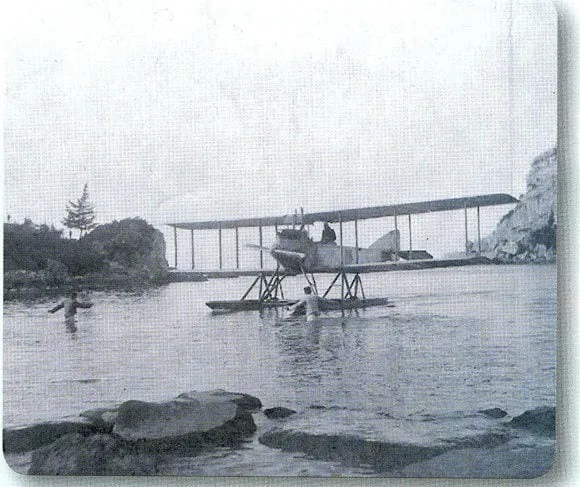
These historical facts, before landing on the pages of the Amasra Urban Culture Research group, lay between the lines of the book entitled THE NAVAL HISTORY OF THE WAR OF INDEPENDENCE. Naval history researcher Hüseyin ÇOBAN came across those lines — and a photograph of a seaplane taken in the small harbour — in this book. Amasrans who remembered the incident described in the book as it passed from hand to hand also confirmed that the depot of the station had been located where the Seymenler now stand. The second piece of news confirming this important event, which had slipped away from living memory, was captured by Salih POLATOĞLU while searching for traces of Amasra on the Internet — two articles on the website tayyareci.com. While we were preparing to bring this information to you through the AKKA writings and the Amasra.net website, the third piece of news reached us in the excited voice of our dear archaeologist friend Nezih BAŞGELEN, editor of the Arkeoloji ve Sanat publishing house, over the telephone. An article about the Amasra Seaplane Station had been published in the magazine Popüler Tarih. Now it remained for us to present this article and these photographs to you.
Savmi Bey’s GOTHAs
With the increase in shipping on the Black Sea, from the end of 1921 onwards Amasra’s small harbour becomes an important supply point. Some of the weapons obtained from Russia or smuggled from depots in Istanbul, and provisions being dispatched to Anatolia, are also unloaded here. At the same time, an initiative is launched in Amasra — through the efforts of Aviation Major Savmi Bey — to establish a naval aircraft base. In November 1921, a decision is made to secretly smuggle three naval aircraft belonging to the Ministry of the Navy out of Istanbul.
This image was published in the magazine Popüler Tarih. However, we do not believe the photograph was taken in Amasra’s Small Harbour.
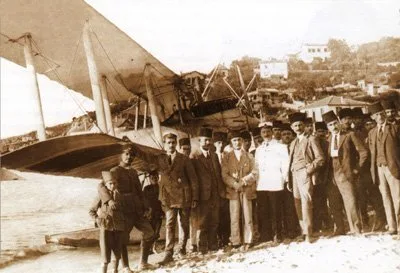
The aircraft are taken from the depots by the secret organisation in Istanbul, the “Muavenet-i Bahriye Grubu” (Naval Assistance Group), and transported to İnebolu. Through the efforts of Savmi Bey, following the transfer of three German-made Gotha-type naval aircraft to Amasra, the first naval aircraft base in the National Struggle is established under the name “Amasra Bahri Tayyare İstasyonu Komutanlığı” (Amasra Naval Seaplane Station Command). Major Savmi Bey is appointed to command. By June 1922, the assembly of the aircraft is completed and an aircraft hangar is built. On 18 June 1922, the repair of the first Gotha-type naval aircraft is completed and trial flights begin. On 3 July 1922, this naval aircraft, which set out from Amasra on a reconnaissance mission, spots the Greek navy’s destroyer Panthir at the mouth of Koprıca near Şile and launches an attack. One of the bombs dropped by Captain Cemal strikes the bow of the destroyer Panthir. The aircraft returns to base to replenish its bombs and fuel and continues the attack. On its second sortie it drops six bombs, but due to foggy weather is unable to observe the result. No lethal damage is inflicted on the destroyer, but the Panthir will be out of action for a considerable time.
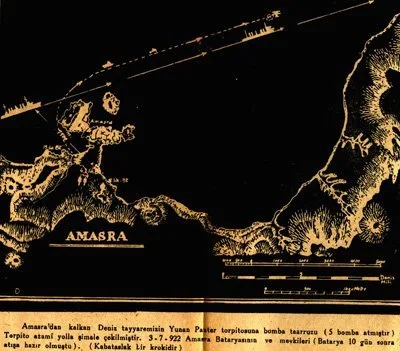
This map and photograph, taken from the book The Naval Front of the War of Independence, marked the beginning of our search for traces of “Amasra Bahri Tayyare” station.
Even this single attack proved to be a significant move in restraining Greek naval activity in the region. In August 1922, the other two aircraft also begin to take part in operations more actively. However, the aircraft are very old and worn; they can only conduct reconnaissance and patrol flights in the Western Black Sea region. On 7 September, orders are issued for the transfer of the Amasra aircraft to Lake Sapanca. The aim is to pursue and pin down Greek forces withdrawing from Anatolia at Gemlik, Bandırma, and Mudanya. On 13 September, Captain Nuri takes off in one of the Gothas towards Sapanca, but the malfunctioning aircraft makes a forced landing on the Akçakoca coast. On 13 October it is brought back to Amasra aboard the cargo vessel Şahin, which was carrying mines to Akçakoca. On 16 September, Captain Cemal and Lieutenant Şerafettin Bey land the second aircraft at Lake Sapanca. On 25 September, the other Gotha flies towards İzmit under the command of Major Savmi Bey. The aircraft, whose engine fails at the mouth of the Sakarya river, lands on the sea. After repair it is sent to İzmit. Meanwhile, in early November, two other naval aircraft found in the Golden Horn warehouses are also sent to İzmit. Thus on 18 November, four naval aircraft — two from Amasra and two from Istanbul — are gathered at İzmit. On 2 December, Major Savmi Bey is appointed to the post of “İzmit Aircraft Station Command.” On 13 December 1922, by order of the General Staff, this naval aircraft base is transferred from İzmit to İzmir.
July 1922; our seaplane, after a reconnaissance sortie and bombing attack on an enemy destroyer, is being manoeuvred back into position in the Small Harbour at Amasra.
How Were the GOTHAs Smuggled?
Members of the Muavenet-i Bahriye Grubu (Naval Assistance Group) in Istanbul — Hulki and Ahmet Beys — establish in November 1921, from the records of the Ministry of the Navy, that 9 Gotha WD-type aircraft delivered to Turkey by the Germans in July and September 1918 are stored in the Golden Horn warehouses. Three of these aircraft that are in good condition are loaded in pieces into crates one night and brought to the Naval War College on Heybeliada. However, following a tip-off, the occupying forces raid the Naval War College. But thanks to the cool-headedness of the school commander, Lieutenant Colonel Şevket Bey, the aircraft parts are saved. A few days later, naval officers and war college students disguised as fishermen transport the aircraft parts — first on fishing boats to İnebolu, and from there overland to Amasra.
Popüler Tarih Magazine / Issue 42 / February 2004 Kansu ŞARMAN
Where to stay and eat in Amasra
 Story
Story Rod Fishing in Amasra and the Flavor Culture from Sea to Table
Rod fishing on Amasra's pier, seasonal Black Sea catches, and how fresh fish travels from the water straight to the table in this cherished coastal town.
 Story
Story Retracing the Footsteps of the Past at Amasra Museum
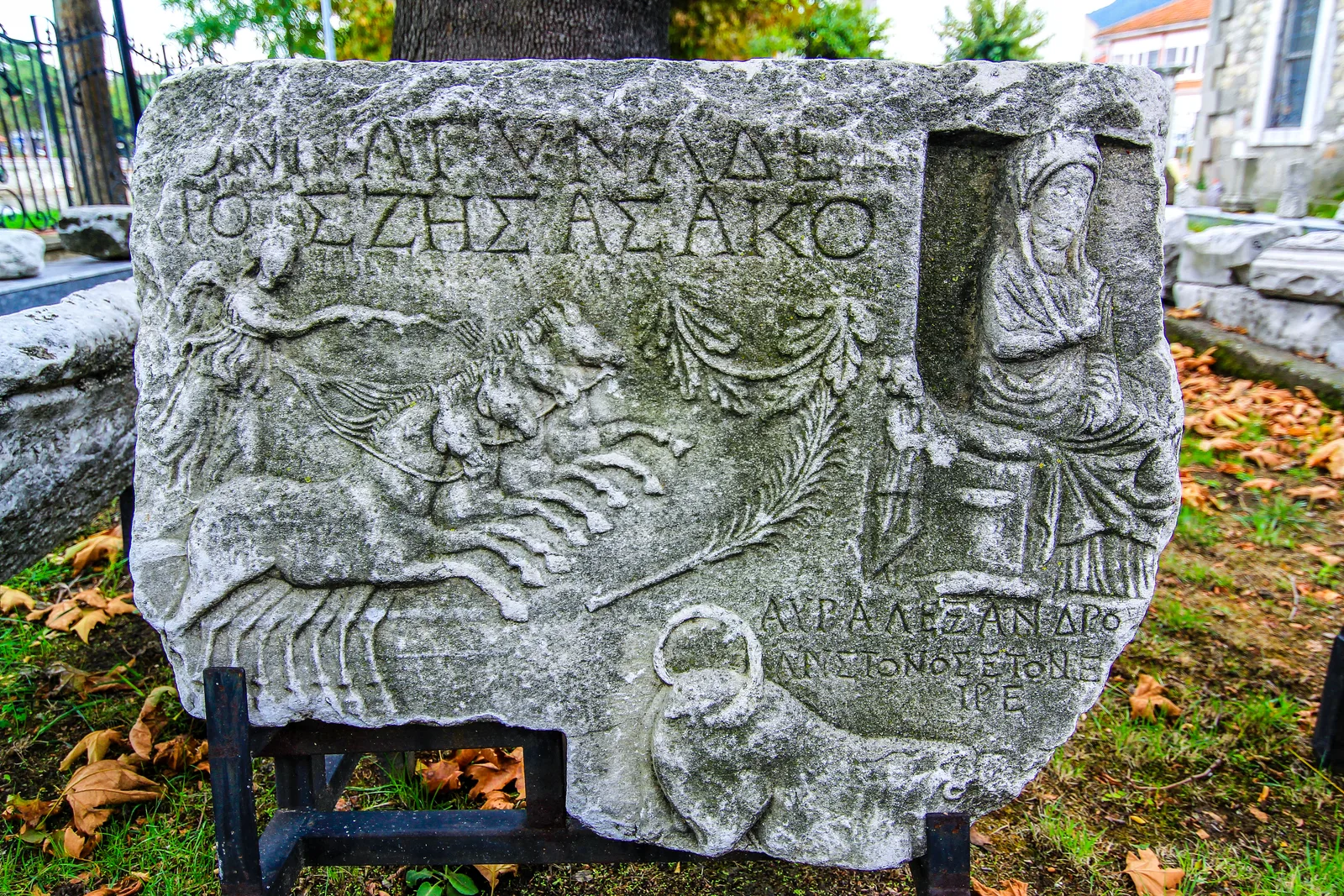
A Hadrian torso, Roman amphorae, bronze coins and an ancient garden: Amasra Museum's stone building on the Small Harbour shore preserves thousands of years of the city's memory.
 Story
Story A Black Sea Tale in the Shadow of Clouds: Amasra
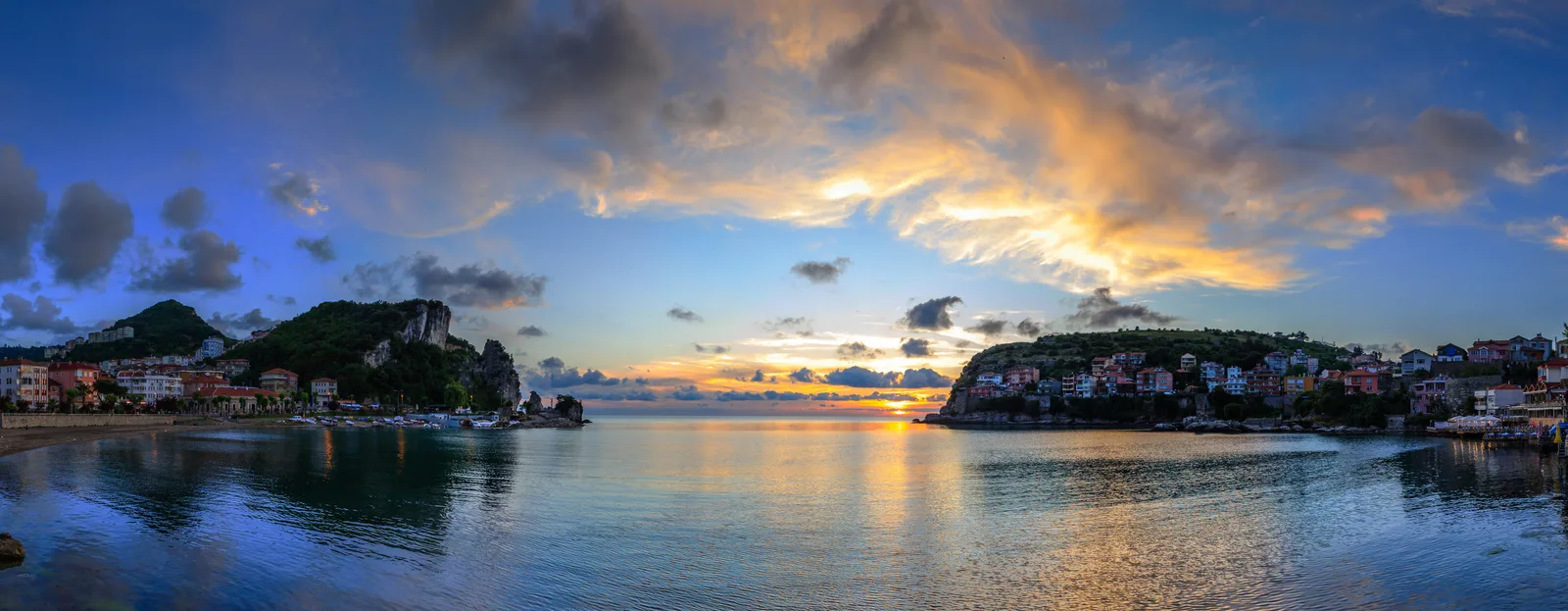
Sunlight filtering through storm clouds turns the Black Sea into a living painting.